
The Silent Danger in Singapore Bathrooms: Why an Open Window Isn’t Enough to Stop Toxic Mould
SINGAPORE — As urban apartments become more tightly sealed and energy-efficient, homeowners across the island are facing a stubborn, microscopic enemy: Stachybotrys chartarum, commonly known as toxic black mould.
While many residents believe that simply leaving a bathroom window cracked open is enough to keep the space fresh, building experts and indoor air quality data tell a wildly different story. Passive ventilation is failing, and the resulting moisture buildup is costing homeowners thousands in property damage and compromising family health.
The 48-Hour Window: How Mould Takes Over
According to environmental health data, mould spores require only two things to colonize a surface: a organic food source (like false ceiling, grout, or paint) and moisture. In a typical humid Singapore bathroom, moisture lingers on surfaces for hours after a shower.
The Data: Mould thrives and begins to replicate within just 24 to 48 hours on a damp surface.
When a bathroom relies solely on a passive, open window, there is no active force pushing the heavy, humid air out. Instead, the steam slowly cools, condenses, and clings to the ceiling and walls. Once mould establishes a foothold, it releases microscopic spores into the air that can trigger persistent allergies, respiratory issues, and asthma—especially in children and the elderly.
The Physics of Clean Air: Active vs. Passive Ventilation
The solution to stopping mould isn’t just opening a door—it requires a fundamental shift in airflow physics. This is where mechanical ventilation comes in.
A mechanical ventilation system, such as a high-performance exhaust fan, works on a simple but highly effective principle: negative pressure.
- Active Expulsion: Instead of waiting for air to drift out naturally, a mechanical fan forcefully draws heavy, moisture-laden air, stubborn odors, and smoke out of the bathroom entirely.
- The Dry Air Exchange: By pushing the damp air out of the house, it creates a vacuum that pulls in cleaner, significantly drier air from the rest of the living area.
This rapid exchange drops the bathroom’s humidity levels below the threshold required for mould to survive, ensuring the space dries completely within minutes of a shower ending. Furthermore, it prevents foul odors or airborne smoke from drifting deeper into the bedrooms and kitchen, keeping the entire household smelling pristine.
Engineering the Solution: The KDK 20WHCT Innovation
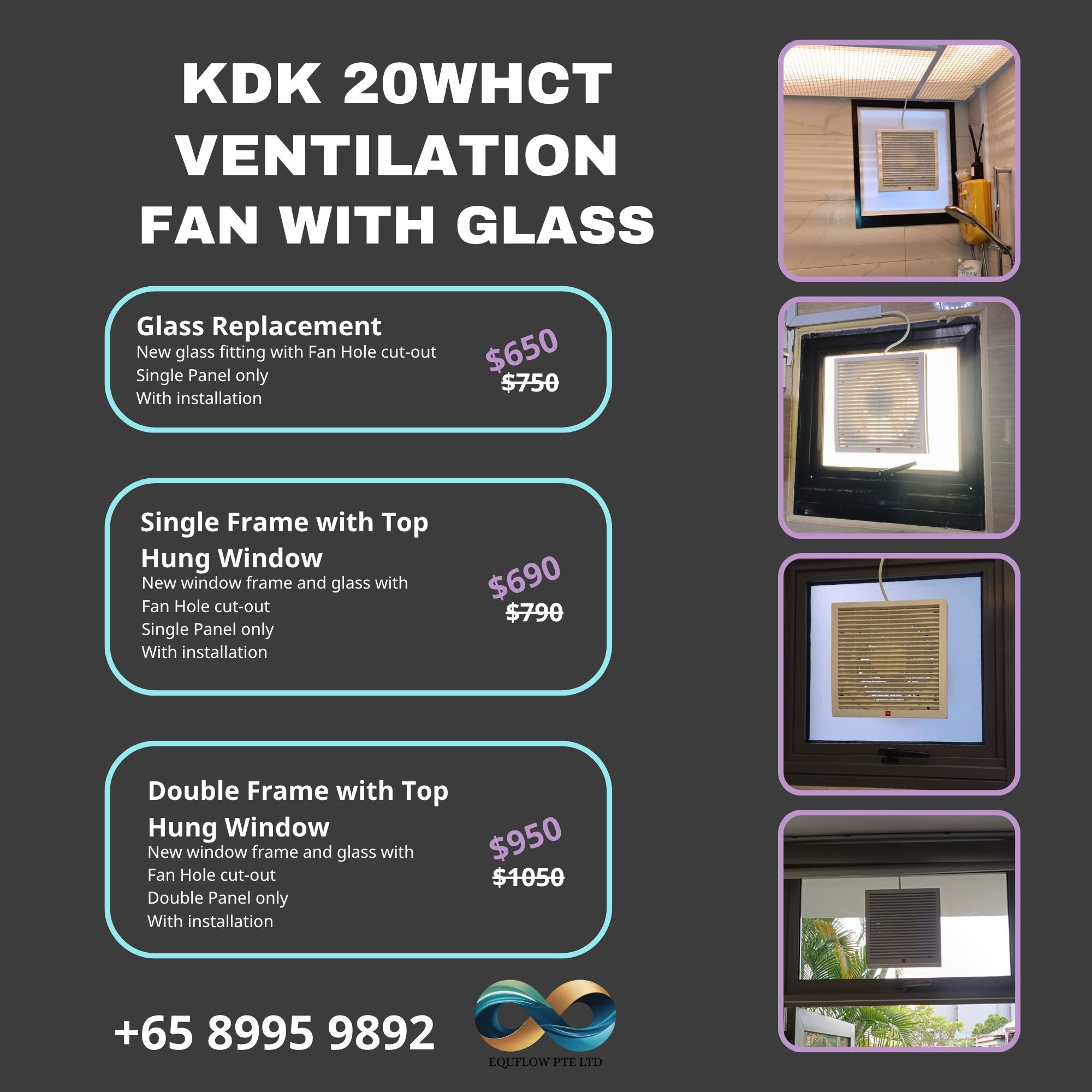
To address this growing structural and health concern, home comfort specialist Equflow Pte Ltd has introduced an all-in-one mechanical ventilation upgrade designed specifically for Singapore’s unique window layouts.
The KDK 20WHCT Ventilation Fan with Glass integrates a premium, high-velocity exhaust fan directly into the bathroom window structure, eliminating the need for messy wall hacking.
To encourage local homeowners to actively protect their properties, Equflow has launched an introductory subsidy on their most popular all-inclusive installation packages:
| Service Package | Standard Rate | Introductory Rate (All-Inclusive) |
| Glass Replacement Package (New glass fitting + fan hole cut-out + installation) | ~~$750~~ | $650 |
| Single Frame with Top Hung Window (New frame and glass with cut-out + installation) | ~~$790~~ | $690 |
| Double Frame with Top Hung Window (Premium double panel upgrade + installation) | ~~$1050~~ | $950 |
A Proactive Approach to Home Value
Repainting a mould-damaged ceiling or replacing ruined bathroom grout can easily cost upwards of $1,000 to $2,000 in recurring maintenance. Experts agree that investing in mechanical ventilation is a far more cost-effective, permanent shield for both your property value and your family’s respiratory health.
Before the damp climate takes a toll on your home, consider upgrading your bathroom’s defenses.
Ready to clear the air?
Contact the installation experts at Equflow Pte Ltd for a consultation.
- 📞 WhatsApp / Call: +65 8995 9892
Leave a Reply